

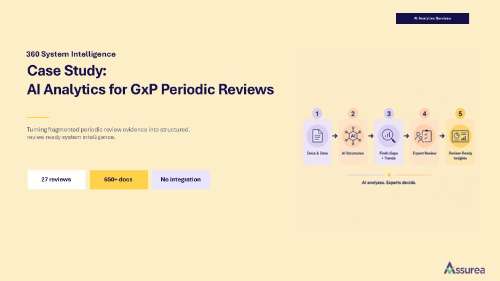
27 periodic reviews. 650+ documents analyzed. One clear view of system health.
Periodic reviews are intended to answer a relatively simple question: is this GxP system or piece of computerized equipment still operating in a controlled and appropriately validated or qualified state?
Getting to that answer is rarely simple.
A reviewer may need to look across change controls, deviations, CAPAs, validation documentation, training records, maintenance history, access reviews, audit-trail reviews, backup evidence and actions from the previous periodic review.
The challenge is not just reviewing each file, but understanding what all of that information means together.
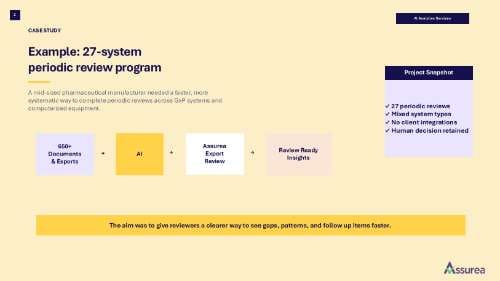
Assurea supported a mid-sized pharmaceutical manufacturer with a periodic-review program covering 27 GxP systems and computerized equipment assets.
Using our custom AI analytics solution together with Assurea’s validation and quality expertise, we analyzed 650+ documents and data exports and converted the information into structured, review-ready insights.
No integration with the client’s QMS, CMMS, LMS or other enterprise systems was required.
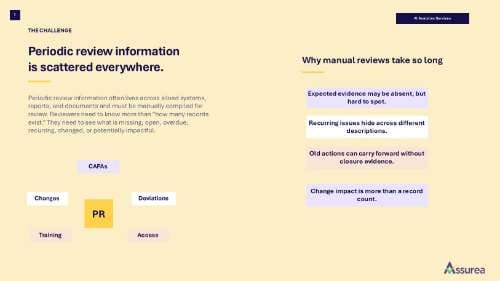
The Challenge: Periodic Review Information Was Everywhere
The 27 reviews covered a mix of manufacturing equipment, laboratory instruments and GxP computerized systems.
For each review, information had to be gathered from multiple sources, including:
- Change-control exports
- Deviation reports
- CAPA reports
- Maintenance and calibration records
- Validation and lifecycle documentation
- Training reports
- User-access reviews
- Audit-trail reviews
- Backup and recovery information
- Security information
- Previous periodic-review reports and actions
A single export could contain dozens of underlying changes, deviations or maintenance events. The reviewer still had to determine what was missing, what was still open, what was overdue, whether similar events were happening repeatedly, whether several changes affected the same system function, whether a CAPA actually solved the problem, whether previous periodic-review actions were closed, and whether anything required assessment of the validated or qualified state.
That is where periodic reviews become time-consuming, and where important patterns can be missed.
The Assurea Approach: AI Analytics Plus Life Sciences Expertise
The client did not need to implement a new platform or integrate its GxP systems with Assurea.
Instead, the client provided the periodic-review information already available for the applicable review period. Across the 27 reviews, Assurea analyzed 650+ documents and data exports.
Our AI analytics evaluated the information through a series of practical periodic-review questions: what’s missing, what’s still open, what’s overdue, what’s recurring, what changed, and what needs human assessment.
Once the analysis was complete, Assurea’s validation and quality specialists reviewed the AI-generated observations, verified supporting evidence, investigated ambiguous findings, eliminated false or irrelevant relationships, identified items requiring client follow-up, and prepared the information needed to support completion of the periodic review.
The technology accelerated the analysis and human expertise remained responsible for the judgment.
What We Found
Most systems were operating without significant unresolved concerns.
Across the 27 systems, 18 systems had no significant unresolved issue requiring escalation, 6 systems required follow-up actions but had no indication of loss of validated or qualified state, and 3 systems contained observations requiring formal client assessment.
That distinction mattered. The goal was not to generate more red flags. It was to help reviewers quickly differentiate between systems that were healthy and systems that genuinely needed attention.
Finding 1: Missing Evidence That Could Easily Be Overlooked
The analysis identified 14 instances of missing or incomplete expected evidence across nine systems, including a required user-access review not included in the review package, backup records available but no restore-verification evidence, a lifecycle document referenced as current when a newer version existed, validation evidence referenced in a change but not included with the review, and previous periodic-review actions without clear closure evidence.
Missing evidence did not automatically mean that a control had failed. It meant something more specific: the review package could not yet demonstrate that the control had been completed.
Finding 2: Previous Actions Had Quietly Carried Forward
Periodic reviews may be performed annually, every two years or according to another risk based frequency. That creates an opportunity for old actions to disappear between review cycles.
Across the portfolio, the analytics identified seven previous periodic review actions without clear closure evidence in the current review package. After follow up, five were confirmed as completed, but closure documentation had not been clearly linked, and two required additional action.
Finding 3: Patterns Were Hidden Across Individual Records
One of the strongest benefits came from trend analysis. Assurea identified six recurring patterns across deviations, CAPAs and maintenance information that warranted additional review.
For one manufacturing system, four corrective-maintenance records used slightly different descriptions but involved the same temperature-control component. Individually, each work order had been completed and each repair appeared acceptable. Together, the records showed a recurring component-failure pattern.
This is an important difference between counting records and analyzing records.
The Operational Impact: Nearly 500 Hours of Estimated Effort Saved
Before using the AI-assisted approach, the client estimated that a typical periodic review required approximately 38 hours per system of combined effort across preparation, document review, analysis, stakeholder follow-up and completion. Across 27 systems, that represented more than 1,000 hours of periodic-review effort.
With Assurea’s AI analytics supporting evidence review and synthesis, average effort decreased to approximately 20 hours per periodic review, an estimated 486 hours saved and roughly a 47% reduction in periodic-review effort, with 27 periodic reviews completed within the planned review cycle.
The efficiency did not come from removing human review. It came from reducing the amount of experienced people’s time spent searching for information, sorting exports, reading repetitive records, manually comparing events, rebuilding summaries, and looking for relationships across multiple sources.
Where AI Stops and Human Expertise Begins
Periodic review is a strong use case for AI because the work combines large volumes of information with expert judgment.
AI is particularly useful for reviewing large document sets, comparing information across sources, finding missing information, connecting similar events, recognizing recurring patterns, and organizing findings for review.
But those capabilities do not replace Quality or validation judgment. The appropriate client stakeholders still determine what the evidence means for the system’s validated or qualified state.
AI provides scale and pattern recognition. Assurea provides the CSV and Quality expertise to determine what those patterns actually mean.
The Outcome: From Fragmented Evidence to 360° System Intelligence
For this pharmaceutical manufacturer, periodic review shifted from a largely manual document-review exercise to a structured assessment of system health.
Across the program: 27 GxP periodic reviews completed, 650+ documents and data exports analyzed, 14 missing or incomplete evidence items identified, 7 previous review actions requiring closure confirmation or follow-up, 6 recurring patterns surfaced across Quality and maintenance information, 3 systems requiring formal validated/qualified-state assessment, approximately 47% estimated reduction in periodic-review effort, and approximately 486 hours of estimated effort saved.
More importantly, the organization gained a clearer picture of what had actually happened across its GxP systems during the review period.
Systems with complete, well-controlled evidence could be recognized faster. Systems requiring attention could be identified earlier. And experienced Quality and Validation professionals could spend less time searching for information and more time making the decisions that require their expertise.
The periodic reviews did not become less rigorous. They became more focused, more systematic and easier to act on.