

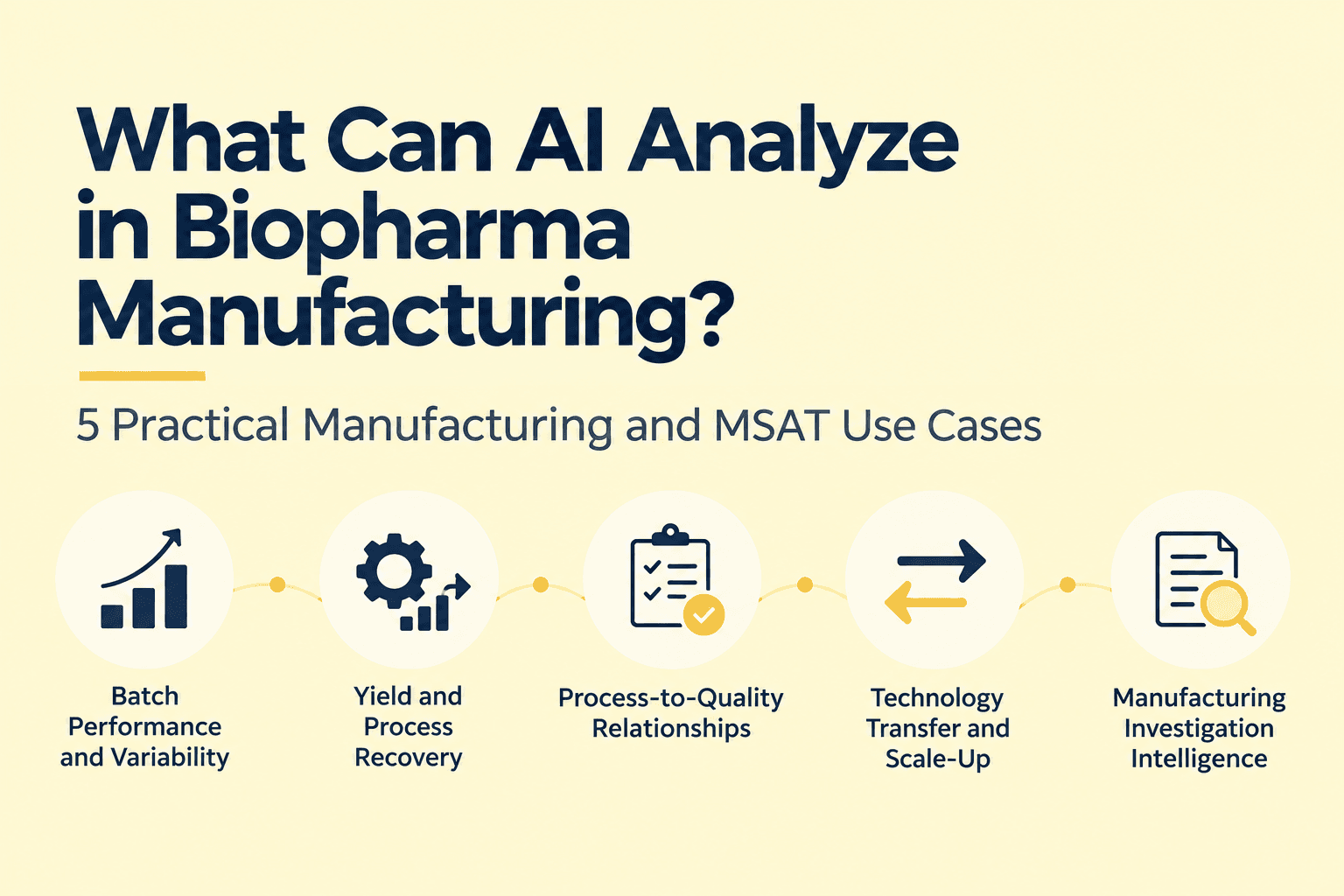
How AI powered analysis can help manufacturing and MSAT teams understand batch performance, yield, quality, investigations and technology transfer using data they already have
Biopharma manufacturing teams already collect a lot of data.
Batch records. Process parameters. In-process testing. Yield and recovery data. QC results. Deviations. Development reports. Tech transfer documents.
The challenge is often finding a useful story across all of it.
When a manufacturing or MSAT team wants to understand why batches are performing differently, someone may need to review dozens of batch records, spreadsheets, analytical results and reports to piece together an answer.
AI powered manufacturing analysis can help make that review faster and more focused.
And it does not always require installing an AI platform or connecting AI directly to the manufacturing environment.
For many Manufacturing Intelligence and MSAT analytics use cases, a company can provide a defined set of historical data and documents for analysis. AI-powered tools can help compare the information, find patterns and narrow down where subject matter experts should look.
That distinction matters. Industry assessments continue to find that biopharma companies often have substantial quality, yield and batch data available, while making that information accessible and usable for process improvement remains a challenge.
What Is Manufacturing and MSAT Intelligence?
Manufacturing Intelligence looks across historical manufacturing information to help answer questions about batch performance, variability, yield and process behavior.
MSAT Intelligence uses that information to support deeper questions around process understanding, investigations, optimization, scale-up and technology transfer.
The two naturally work together.
A Manufacturing Intelligence analysis might identify that certain conditions repeatedly appear in lower-performing batches. MSAT can then determine whether those findings make scientific sense and whether they should be investigated further.
What information can be analyzed?
Depending on the question, a company could provide:
- Historical batch data
- Batch records
- Process parameter exports
- In-process testing results
- QC and analytical results
- Yield and recovery data
- Deviations and investigation reports
- Development reports
- Process characterization studies
- Technology transfer documents
- Engineering or PPQ batch information
The information needed depends on the problem being solved. You do not necessarily need every piece of manufacturing data to get started.
1. Batch Performance and Variability Analysis
The question: Why do some batches perform better than others?
Imagine a manufacturer has produced 75 batches.
Some consistently perform well. Others have lower yield, longer processing times or different analytical results.
The information exists, but comparing 75 batches manually can take a significant amount of SME time.
What could be analyzed?
The manufacturer might provide:
- Historical batch information
- Key process parameters
- In-process results
- Yield and recovery
- QC results
- Relevant deviations
- Material information
What does Assurea actually look for?
In plain English, we ask:
- What is different between stronger and weaker batches?
- What do the stronger batches have in common?
- What repeatedly shows up in lower-performing batches?
- Are certain combinations of process conditions associated with different results?
- Are there batches that behave very differently from the rest?
- Has performance changed over time?
Instead of reviewing one parameter or one batch at a time, the analysis looks across the historical population.
What could the team get back?
For example:
Across 75 historical batches, five process factors were most consistently associated with differences in batch performance and should be investigated further.
That does not mean AI has proven that those five factors caused the difference.
It means MSAT now has a much smaller and more useful place to start.
Why does it matter?
Instead of asking experienced scientists and engineers to manually compare dozens of batches and hundreds of variables, the analysis can help narrow a large amount of information into a focused set of questions.
That can save review time and help Process Development and MSAT focus experimental work where the historical manufacturing data suggests it may be most useful.
2. Yield and Process Recovery Analysis
The question: Where are we losing product?
A manufacturer may know that final yield varies between batches.
But final yield does not tell you where the difference happened.
One group of batches could have lower production upstream. Another could produce similar amounts initially but lose more product during downstream processing.
What could be analyzed?
The company might provide:
- Batch yield data
- In-process measurements
- Harvest results
- Recovery at different process stages
- Purification results
- Process parameters
- Final analytical results
What does Assurea actually look for?
We break the process into meaningful stages and ask:
- Where does the biggest loss occur?
- Is that loss consistent across multiple batches?
- Do lower-yield batches tend to lose product at the same stage?
- What was different in batches with better recovery?
- Are particular process conditions associated with greater losses?
- Has recovery at a particular step changed over time?
For a biologics process, for example, the analysis might compare:
- Production
- Harvest
- Clarification
- Capture
- Purification
- Polishing
- UF/DF
- Final recovery
What could the team get back?
An analysis might show:
Upstream production was similar across the batch population, but lower-performing batches consistently experienced greater product loss during one downstream stage.
That gives the manufacturing and MSAT teams somewhere specific to investigate.
Why does it matter?
Even a modest improvement in recovery can matter when the product is expensive to manufacture.
Instead of treating “low yield” as one large problem, yield and recovery analysis can help determine where the opportunity actually sits.
3. Process-to-Quality Relationship Analysis
The question: Are things happening during manufacturing connected to our final quality results?
Manufacturing data and laboratory data are often reviewed separately.
But some of the most useful questions require looking at them together.
For example:
Do batches with certain manufacturing conditions also tend to have different potency results?
Or:
Are higher impurity results associated with something that happened earlier in the process?
What could be analyzed?
A company might provide:
- Process parameters
- Batch data
- In-process results
- QC and analytical results
- Potency results
- Purity results
- Impurity results
- Other relevant quality attributes
What does Assurea actually look for?
We ask practical questions such as:
- What was happening during manufacturing in batches with stronger quality results?
- What was different in batches with weaker results?
- Do certain process conditions repeatedly appear alongside particular QC results?
- Are there combinations of conditions that seem more important than any one parameter by itself?
- Did something change earlier in the process before the analytical result changed?
The analysis can also look at how a parameter behaved throughout the process, not simply whether it stayed inside an acceptable range.
What could the team get back?
For example:
Batches with a particular combination of process conditions consistently showed a different analytical outcome than the rest of the historical population.
That relationship becomes something for the appropriate SMEs to investigate scientifically.
Why does it matter?
The manufacturer can start connecting what happened during the process with what was eventually measured in the laboratory.
That can help MSAT better understand process performance and prioritize future process characterization or optimization work.
4. Technology Transfer and Scale-Up Gap Analysis
The question: What changed when we moved the process?
Technology transfer can involve a large amount of information.
A process may move:
- From development into manufacturing
- From small scale to larger scale
- From one facility to another
- From a biotech company to a CDMO
- From one manufacturing site to another
Teams then need to determine whether the process, equipment, controls, testing and process knowledge transferred correctly.
Technology transfer is fundamentally a knowledge-transfer exercise, and established industry guidance emphasizes transferring process understanding, CPPs, CQAs, control strategies and other process knowledge between sending and receiving organizations.
What could be analyzed?
A company could provide:
- Development reports
- Process descriptions
- Process characterization studies
- CPP/CQA assessments
- Master batch records
- Sending-site documentation
- Receiving-site documentation
- Engineering batch records
- PPQ documentation
- Technology transfer protocols and reports
- Deviations
- Analytical summaries
This use case can be heavily document-based.
What does Assurea actually look for?
- What changed?
- What doesn’t match?
- What’s missing?
For example:
- Are the process steps the same?
- Are parameter ranges different?
- Did equipment change?
- Did sampling or testing change?
- Are CPPs and CQAs treated consistently?
- Is important process knowledge present in one document but missing from another?
- Did results change as the process scaled?
- Are there differences between the sending and receiving sites?
- Are there open questions that should be resolved before the next manufacturing stage?
What could the team get back?
Instead of hundreds of documents being reviewed independently, the output could provide:
- Key differences
- Missing information
- Inconsistencies
- Areas requiring clarification
- Potential process risks
- Questions for MSAT
- Priority items requiring SME review
This is not simply an AI document summary.
It is a technology transfer and scale-up gap assessment supported by AI-assisted comparison and life-sciences SME review.
Why does it matter?
Technology transfer is already complex and resource-intensive, particularly for newer modalities. Current industry discussion around cell and gene therapy, for example, continues to identify technology transfer from development into GMP manufacturing as a potential source of delays and scale-up difficulty.
Making the comparison faster and more structured can help teams identify gaps earlier rather than finding them during later manufacturing activities.
5. Manufacturing Investigation Intelligence
The question: Something went wrong. Have we seen anything like this before?
Manufacturing investigations often require looking backward.
A batch may have:
- Unexpectedly low yield
- A process excursion
- An unusual in-process result
- Higher-than-expected product loss
- A manufacturing deviation
- An atypical analytical result
The investigation team then needs to determine what happened and whether similar events have occurred before.
What could be analyzed?
Depending on the event, the company could provide:
- The current batch information
- Historical batch records
- Process data
- Previous deviations
- Investigation reports
- Equipment information
- Material information
- QC results
- Relevant process-development reports
What does Assurea actually look for?
We ask:
- Have we seen a similar event before?
- Which historical batches look most like this one?
- What happened in those batches?
- Are the same process conditions showing up again?
- Is the same equipment involved?
- Are there common material lots or suppliers?
- Did similar batches have related analytical results?
- Were previous deviations or investigations potentially related?
- What was different about this batch compared with normal historical performance?
AI is particularly useful here because it can help search and compare information across a large historical population, including both structured data and documents.
What could the team get back?
The team is not just getting back: “AI determined the root cause.”
The analysis identifies the historical events, process patterns, and previous investigations most relevant to the current issue, giving the investigation team a focused set of evidence to review rather than only determining the root cause for them.
That is an important distinction.
Why does it matter?
Experienced manufacturing and MSAT SMEs should spend their time evaluating evidence and making scientific judgments, not spending hours searching for the evidence in the first place.
AI-powered investigation intelligence can help bring the most relevant information to them faster.
Five Manufacturing and MSAT AI Use Cases at a Glance
| Business Question | Analysis | What the Team Gets |
| Why are batches different? | Batch performance and variability | Factors and patterns worth investigating |
| Where are we losing product? | Yield and recovery | Process stages and conditions to investigate |
| What may be affecting quality? | Process-to-quality analysis | Relationships between manufacturing and analytical results |
| What changed during transfer or scale-up? | Tech transfer and scale-up gap analysis | Differences, gaps and questions requiring attention |
| Have we seen this problem before? | Manufacturing investigation intelligence | Relevant historical events, patterns and previous investigations |
What Does a Manufacturing Intelligence Project Actually Look Like?
Not every AI manufacturing project needs to begin with a new system or a large integration project.
A focused analysis can begin with one useful question.
For example:
Why has downstream recovery varied across our last 50 batches?
The client provides the relevant historical data and supporting documents.
Assurea can then:
- Organize the information so batches can be compared consistently
- Compare stronger and weaker performance
- Look for repeated patterns and meaningful differences
- Use AI and analytics to narrow large datasets or document sets
- Have manufacturing and life-sciences SMEs review the findings in context
- Prioritize the observations that deserve further investigation
- Provide the analysis and supporting evidence back to the client
The client’s Manufacturing, Process Development and MSAT experts determine what the findings mean scientifically and what should happen next.
For this type of project, an AI platform does not necessarily need to be installed in the client’s manufacturing environment.
What Should AI Do?
AI is useful when there is simply too much information to review efficiently one record at a time.
It can help:
- Compare many batches at once
- Search large document sets
- Find repeated patterns
- Find unusual results
- Identify relationships between different types of data
- Compare documents
- Group similar events
- Highlight information for SME review
But finding a relationship does not automatically prove why something happened.
AI should help experts find where to look.
Manufacturing, MSAT, Process Development and Quality SMEs still determine what the information means and whether additional investigation, experimentation or action is appropriate.
This human context is particularly important in biopharmaceutical process analytics; current industry work around AI-enabled process monitoring continues to emphasize combining advanced analytics with process knowledge and SME evaluation.
Frequently Asked Questions
How can AI be used in biopharma manufacturing?
AI can help analyze historical batch data, process parameters, manufacturing documents, yield and recovery data, QC results and investigations. It can identify patterns, differences and relationships that help Manufacturing and MSAT teams focus their technical review.
How can AI help MSAT teams?
AI can help MSAT teams compare batches, investigate variability, analyze yield and recovery, connect process conditions with quality results, compare technology transfer documentation and search historical manufacturing information during investigations.
Can AI analyze historical batch data?
Yes. Historical batch data can be compared across a population to identify common patterns, unusual batches and factors associated with stronger or weaker performance. Statistical process monitoring and trending are already established parts of biopharmaceutical process understanding, while AI and machine-learning methods can extend the types of multivariate patterns that can be evaluated.
Can AI help identify causes of batch-to-batch variability?
AI can help identify factors and patterns associated with variability. It should not automatically be assumed that those factors caused the difference. The findings can give Manufacturing, Process Development and MSAT a more focused starting point for scientific investigation.
Can AI support pharmaceutical technology transfer?
Yes. AI-assisted analysis can compare process descriptions, batch records, parameter ranges, development reports, analytical results and other technology transfer information to identify differences, gaps and areas requiring SME attention.
Do we need to integrate an AI platform into our manufacturing systems?
Not necessarily.
Many Manufacturing Intelligence and MSAT analytics projects can begin with exported historical data, batch records, reports and other defined information.
That information can be analyzed as a focused project without installing an AI platform directly into the manufacturing environment.