

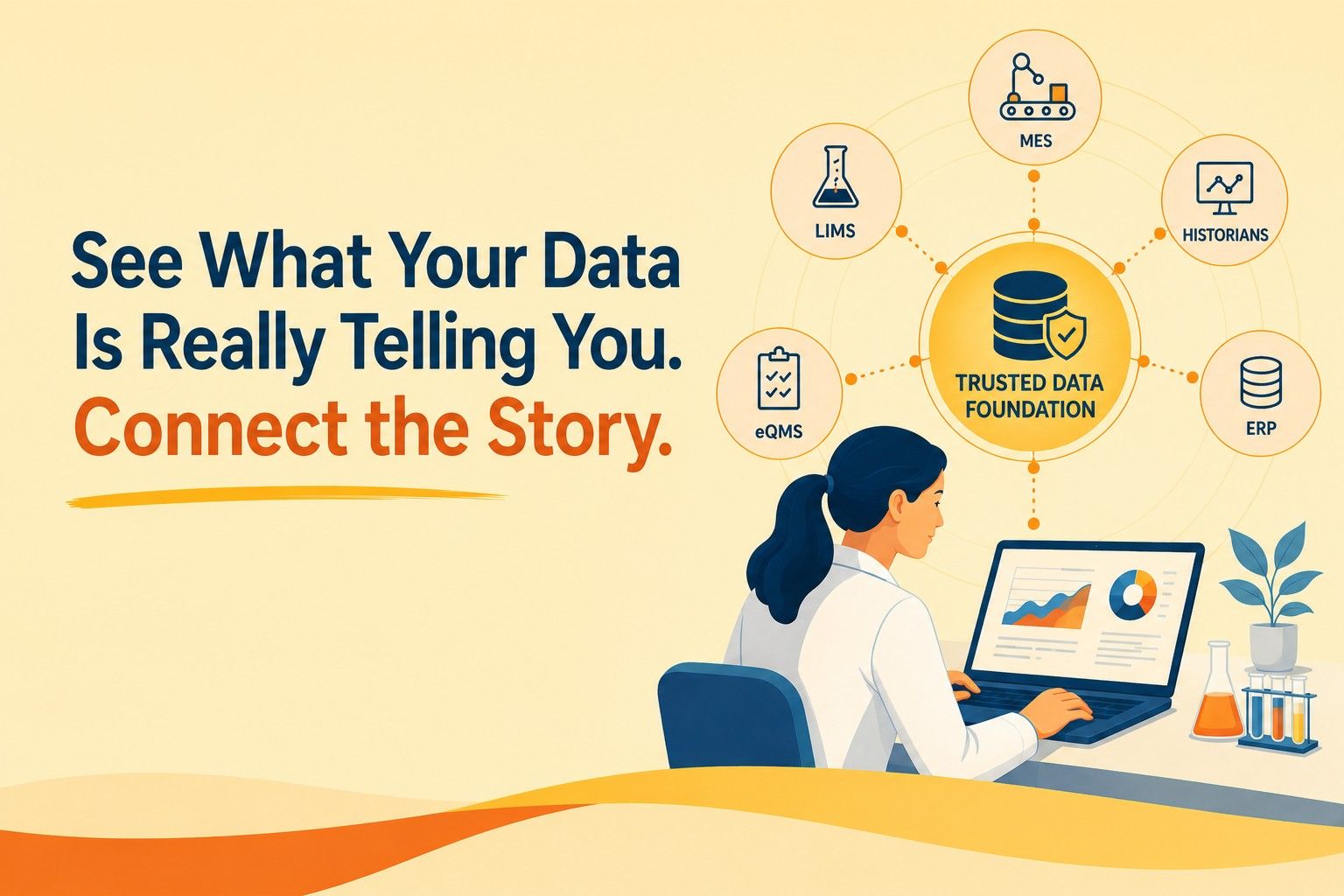
A biotech company may already have the data it needs to answer an important question. The problem is that the answer may be spread across five different systems.
Consider one batch. The MES knows what happened during execution. The historian captures process conditions. LIMS contains laboratory results. The eQMS holds deviations and investigations. ERP contains material and production information.
The data exists. But bringing it together may still require several people, manual exports and spreadsheets.
This is where life sciences data modernization becomes important.
What Is Data Modernization in Life Sciences?
Data modernization improves how data is collected, connected, structured, governed and used across a life sciences organization. It brings together data from manufacturing, laboratory, quality and enterprise systems to create trusted information for reporting, analytics and AI.
For GxP data, there is another consideration: modernization must preserve the integrity, context and traceability needed for how that data will be used.
Why Is Data Modernization Different in Life Sciences?
Life sciences companies rarely operate from one system.
Data may be spread across Manufacturing Execution Systems (MES), Laboratory Information Management Systems (LIMS), electronic Quality Management Systems (eQMS), Enterprise Resource Planning (ERP), SCADA and historians, laboratory instruments and software, data warehouses and cloud platforms, spreadsheets and files, and other enterprise applications.
Each system may work well on its own while the data remains difficult to use together.
Imagine a manufacturing team trying to understand why yield declined across several batches. Process conditions may be in the historian. Batch execution data may be in MES. Test results may be in LIMS. Related deviations may be in the eQMS. Someone still has to connect the dots.
Data modernization is about making the right data work together.
What Does a Modern Life Sciences Data Environment Look Like?
A modern data environment connects information from different systems and gives it enough structure, context and governance to be used with confidence.
This does not mean every company needs the same architecture. A growing biotech preparing for commercialization should not automatically build the same data environment as a global pharmaceutical company with dozens of manufacturing sites.
The technology behind each layer can vary. Platforms such as Microsoft Azure, AWS, Snowflake, Databricks or Microsoft Fabric may support parts of the environment.
The important question is not which platform is most popular. It is: what does your organization need its data to do?
Start With the Question, Not the Technology
It is tempting to start a modernization program by asking whether to use a data warehouse or lakehouse, or whether to implement Snowflake or Databricks. Those questions matter eventually, but they are rarely the best place to start.
Start with questions such as why certain batches are experiencing lower yield, whether laboratory and manufacturing results can be viewed together, whether certain types of deviations are increasing, whether manufacturing performance can be compared across sites, how much manual work is required to prepare a product quality review, and what data would be required for a planned analytics or AI use case.
Once the question is clear, the organization can determine which data is needed, where it lives and what needs to change.
A Practical Life Sciences Data Modernization Roadmap
Data modernization does not have to mean replacing every system or integrating everything at once. A practical approach can follow six steps.
Assess: understand what you have. Start by mapping the current environment. Identify the systems, data sources, owners, interfaces and dependencies involved. A useful current-state assessment shows how data actually moves through the organization, including the manual steps between systems.
Prioritize: decide what you need the data to do. Not every data source needs to be modernized at once. Start with valuable use cases such as improving manufacturing reporting, combining process and laboratory data, identifying quality trends, comparing performance across sites, reducing manual data preparation, or preparing trusted data for analytics and AI.
Architect: design around the use case. Once the use case and required data are understood, the target architecture can be designed, whether that is a data warehouse, data lake, lakehouse, or a combination. There is no single correct choice for every life sciences organization.
Connect and harmonize: make the data work together. APIs and data pipelines can connect systems and move information into the target data environment. But moving data is only part of the problem. Before analyzing information together, the organization needs to determine whether fields across systems represent the same thing and establish how they relate.
Govern and verify: make the data trustworthy. Making data available is not the same as making it trustworthy. This is where data quality, metadata, reconciliation, lineage, ownership and access controls matter.
Use and scale: put the data to work. Once trusted data is available, it can support reporting and dashboards, cross-system analytics, manufacturing intelligence, quality insights, process improvement, and AI and machine learning. The organization can then expand the same foundation to additional systems, sites and use cases.
What Changes When the Data Is GxP?
This is an important distinction in life sciences. The question is not simply whether a company is operating in a regulated industry, but how the data will be used, what decisions depend on it, and what the risk is if it is incomplete, incorrect or changed.
General data modernization focuses on moving data, transforming data, building pipelines, migrating records, managing access, monitoring quality, changing a pipeline, and preparing AI datasets.
GxP-aware data modernization focuses on preserving integrity and context, understanding and controlling critical transformations, maintaining appropriate traceability, mapping and reconciling and verifying data, applying appropriate access controls, defining controls based on intended use and criticality, assessing the impact on regulated use, and maintaining appropriate provenance and traceability.
This does not mean every pipeline, dataset or analytics environment requires the same level of control. The approach should reflect intended use, data criticality and risk.
When Is Life Sciences Data Ready for Analytics and AI?
Having a large amount of data does not make an organization AI-ready.
Consider an AI application intended to identify relationships between manufacturing conditions and quality events. It may need historian data, MES data, LIMS results and eQMS events. If those systems cannot reliably identify the same batch, the AI has a problem before a model is even built.
Data intended for analytics or AI should be relevant to the use case, accessible, sufficiently complete, consistently understood and appropriately traceable.
AI readiness often starts as a data engineering problem. Before asking what AI can learn from the data, make sure the data can be reliably connected and understood.
Where Should a Biotech or Pharma Company Start?
You do not need to connect 25 systems to begin modernizing your data. Start with one valuable problem.
For example, a biotech may want better visibility into manufacturing performance. The first phase might connect MES, LIMS and historian data around a defined set of manufacturing questions. That creates an opportunity to establish the architecture, pipelines, common identifiers, quality rules and governance approach on a manageable scale. Then expand.
A practical sequence is to pick a problem, find the data, understand the gaps, build the smallest useful foundation, prove value, and scale.
Data modernization should be a roadmap, not a big-bang technology project.
Building a Practical Data Foundation
Life sciences companies do not necessarily need more data. They need to make the data they already generate easier to connect, understand and trust.
Assurea helps biotech and pharmaceutical organizations assess their current data environments and build practical modernization roadmaps. Our services span data strategy and architecture, data integration and engineering, cloud data platform modernization, data governance and quality, and analytics and AI-ready data foundations.
What makes this work different in life sciences is the environment around the data. Manufacturing, laboratory and quality information may support regulated processes and decisions. Data engineering and GxP considerations therefore cannot always be treated as separate conversations.
The starting point does not need to be a major transformation. Start with the problem you are trying to solve. Then determine what your data needs to do differently.