

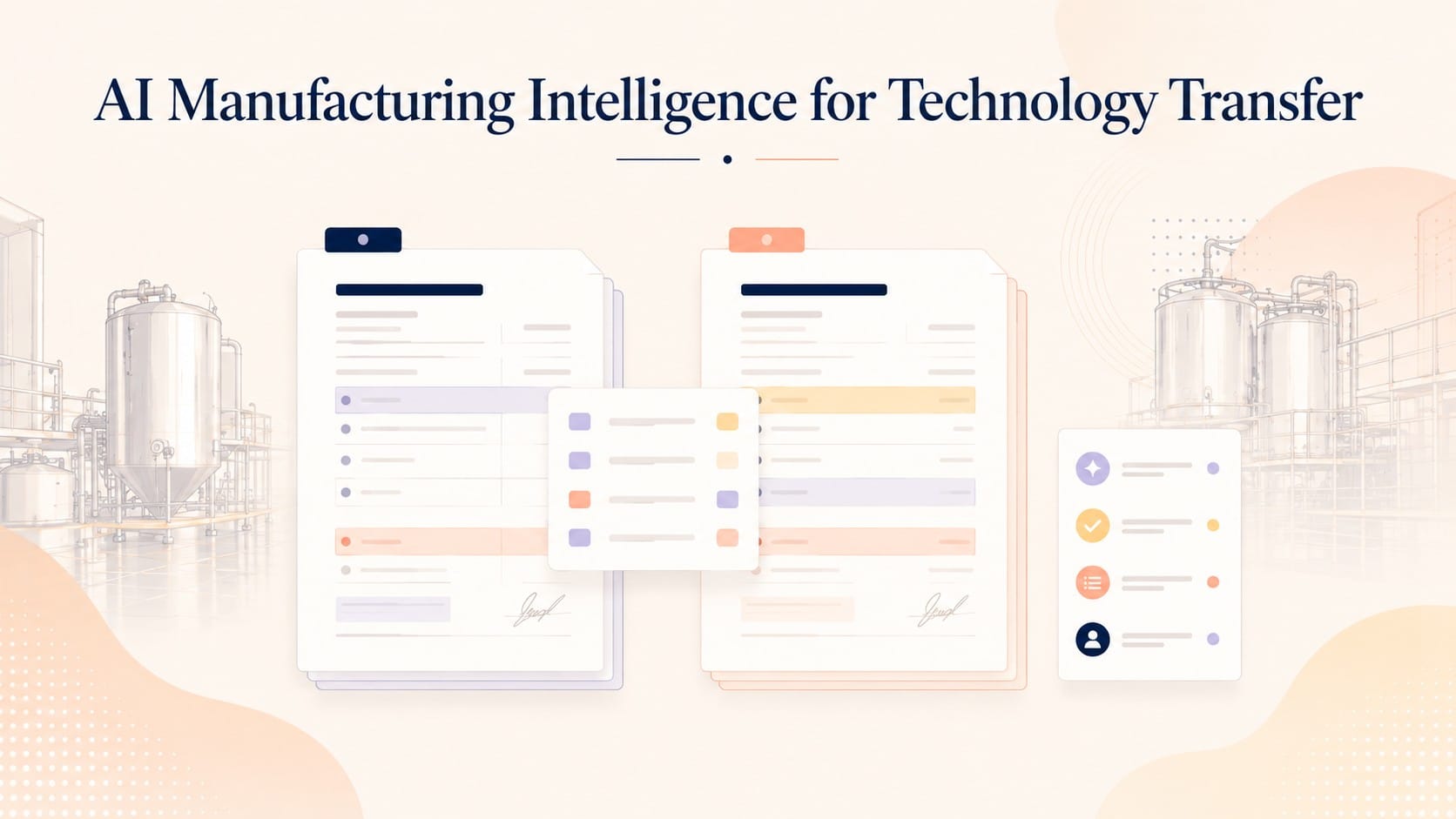
How AI-powered document analytics helps manufacturing teams compare complex documentation, identify process differences, and accelerate technology transfer while keeping GMP decisions under human oversight.
Technology Transfer Is Still a Documentation-Intensive Process
Successful technology transfer is about far more than moving a manufacturing process from one facility to another. It requires ensuring that manufacturing knowledge is accurately transferred, documented, reviewed, and understood before production can begin at the receiving site.
Whether introducing a new product, expanding manufacturing capacity, or aligning operations across global facilities, manufacturing, MSAT, and Technology Transfer teams spend significant time reviewing documentation to understand exactly what has changed and what those changes mean for their own manufacturing process.
A single manufacturing change may affect multiple controlled documents, including:
- Master Batch Records (MBRs)
- Manufacturing procedures
- Work instructions
- Process validation documentation
- Manufacturing risk assessments
- Technology Transfer documentation
- Supporting manufacturing instructions
While digital manufacturing systems have improved document management, comparing complex manufacturing documentation remains largely a manual activity. Teams often spend days reviewing hundreds of pages to determine whether manufacturing instructions, process parameters, equipment requirements, or execution sequences have changed between document revisions or manufacturing sites.
As organizations continue expanding their global manufacturing networks, this manual review process becomes increasingly difficult to scale.
AI is not intended to replace manufacturing expertise. Instead, it can reduce the manual effort required to analyze manufacturing documentation, allowing experienced subject matter experts to focus on evaluating process changes, product quality, and manufacturing readiness.
Why Traditional Reviews Take So Long
One of the biggest challenges during technology transfer is not finding documentation. It’s understanding exactly what changed.
Although document revision history provides a summary of updates, it rarely captures every detailed modification made throughout a Master Batch Record or manufacturing procedure. Small process changes, updated instructions, revised sequencing, or modified process parameters may require reviewers to manually compare hundreds of pages before determining whether additional evaluation is necessary.
Manufacturing teams routinely review documentation to:
- Compare Master Batch Record revisions
- Evaluate manufacturing procedures between sending and receiving sites
- Identify process differences
- Review equipment or process updates
- Support manufacturing process harmonization
- Standardize manufacturing documentation across global sites
For large manufacturing documents, these activities are often performed manually by experienced engineers and manufacturing SMEs. While their technical expertise is essential, much of their time is spent searching for differences rather than evaluating the significance of those differences.
Missing even a seemingly minor change can result in additional review cycles, unnecessary document revisions, delayed technology transfer activities, or inconsistent manufacturing execution between sites.
Reducing the effort required to identify changes allows manufacturing teams to focus on technical decision-making rather than document comparison.
How AI-Powered Document Analytics Helps
AI-powered document analytics can significantly accelerate manufacturing documentation reviews by analyzing large document sets and highlighting areas that require human attention.
Rather than manually reviewing hundreds of pages line by line, AI can rapidly analyze complete manufacturing documents and present structured comparisons for subject matter expert evaluation.
Examples include:
- Comparing complete Master Batch Records across manufacturing sites
- Comparing current and previous document revisions simultaneously
- Identifying added, removed, or modified manufacturing instructions
- Highlighting process differences that may not be obvious from revision history
- Mapping equivalent manufacturing sections across multiple documents
- Detecting duplicate or inconsistent manufacturing content
- Generating structured summaries that support technical review
One of the greatest advantages of AI is its ability to perform multiple analytical comparisons simultaneously. While a reviewer may compare two document revisions sequentially, AI can evaluate multiple revisions, document versions, and manufacturing records in parallel, providing broader review coverage within a fraction of the time.
Importantly, AI is supporting document analysis—not making manufacturing decisions.
Human-in-the-Loop
Manufacturing, MSAT, and Quality professionals remain responsible for:
- Evaluating process suitability
- Assessing potential product quality impact
- Determining validation requirements
- Confirming GMP compliance
- Approving manufacturing documentation
- Making final implementation decisions
This approach combines the efficiency of AI with the technical expertise and regulatory oversight required in GMP manufacturing.
Example: Cross-Site Master Batch Record Review
One example of applying AI to manufacturing documentation involved the comparison of Master Batch Records across two manufacturing sites producing the same product.
Whenever the primary manufacturing site updated its Master Batch Record, the secondary manufacturing site needed to determine whether corresponding updates were required before implementing those changes locally.
Although revision history summarized major document updates, it did not provide the level of detail needed to understand every manufacturing process change. Manufacturing reviewers still needed to perform detailed comparisons across hundreds of pages to determine exactly what had changed.
The project presented several unique challenges:
- Production Master Batch Records ranging from approximately 400 to 800 pages
- Multiple document revisions requiring simultaneous comparison
- Bilingual manufacturing documentation in English and French
- Cross-site manufacturing processes that required alignment while accounting for site-specific differences
Rather than relying solely on manual document review, Assurea developed an AI-powered document analytics workflow to support the comparison process.
The solution analyzed complete manufacturing documents to:
- Compare Master Batch Records across both manufacturing sites
- Compare previous and current document revisions simultaneously
- Map equivalent manufacturing sections between documents
- Identify detailed process differences beyond revision history
- Highlight added, removed, or modified manufacturing instructions
- Generate structured, side-by-side comparisons for SME evaluation
- Perform multiple analytical comparisons simultaneously to provide broader review coverage
Instead of spending days manually reviewing hundreds of pages, manufacturing teams could immediately focus on evaluating meaningful process differences and determining whether updates were required for the receiving site.
The AI accelerated document analysis while maintaining human oversight throughout the review process. Final manufacturing decisions, process updates, and document approvals remained under the responsibility of qualified Manufacturing, MSAT, and Quality personnel.
This approach not only reduced manual review effort but also created a more structured and repeatable process for future manufacturing document comparisons.
Where AI Delivers the Greatest Value
Although this example focused on Master Batch Record comparisons, the same approach can be applied across many manufacturing activities where large volumes of documentation must be reviewed.
Common applications include:
- Technology transfer between manufacturing sites
- Master Batch Record (MBR) comparisons
- Manufacturing procedure reviews
- Manufacturing process harmonization
- Cross-site manufacturing alignment
- Manufacturing documentation standardization
- Continuous process improvement initiatives
- Manufacturing document revision reviews
As organizations continue to expand globally, documentation continues to grow in both volume and complexity. AI helps manufacturing teams process that information more efficiently while allowing subject matter experts to concentrate on technical evaluation and decision-making.
The Future of Technology Transfer
Technology transfer will always rely on experienced Manufacturing, MSAT, Engineering, and Quality professionals.
AI is not replacing those experts.
Instead, it is transforming how manufacturing documentation is reviewed.
Rather than spending valuable engineering time locating differences across hundreds of pages, AI can rapidly analyze manufacturing documentation and organize information into structured comparisons that support faster technical review.
As digital manufacturing continues to evolve, organizations will increasingly look beyond document management toward document intelligence—using AI to transform manufacturing documentation into actionable insights.
The greatest value is not replacing human expertise, but enabling experts to spend more time evaluating process knowledge, manufacturing readiness, and product quality instead of performing repetitive document comparisons.
Conclusion
Manufacturing documentation remains one of the most resource-intensive aspects of technology transfer. As organizations expand manufacturing operations across multiple sites, the ability to efficiently compare, analyze, and understand complex documentation becomes increasingly important.
AI-powered document analytics provides an opportunity to accelerate these reviews by identifying process differences, organizing information, and supporting technical evaluations that would otherwise require significant manual effort.
By combining AI with Human-in-the-Loop review, biotechnology organizations can improve efficiency while maintaining the scientific judgement, manufacturing expertise, and GMP oversight required for successful technology transfer.