

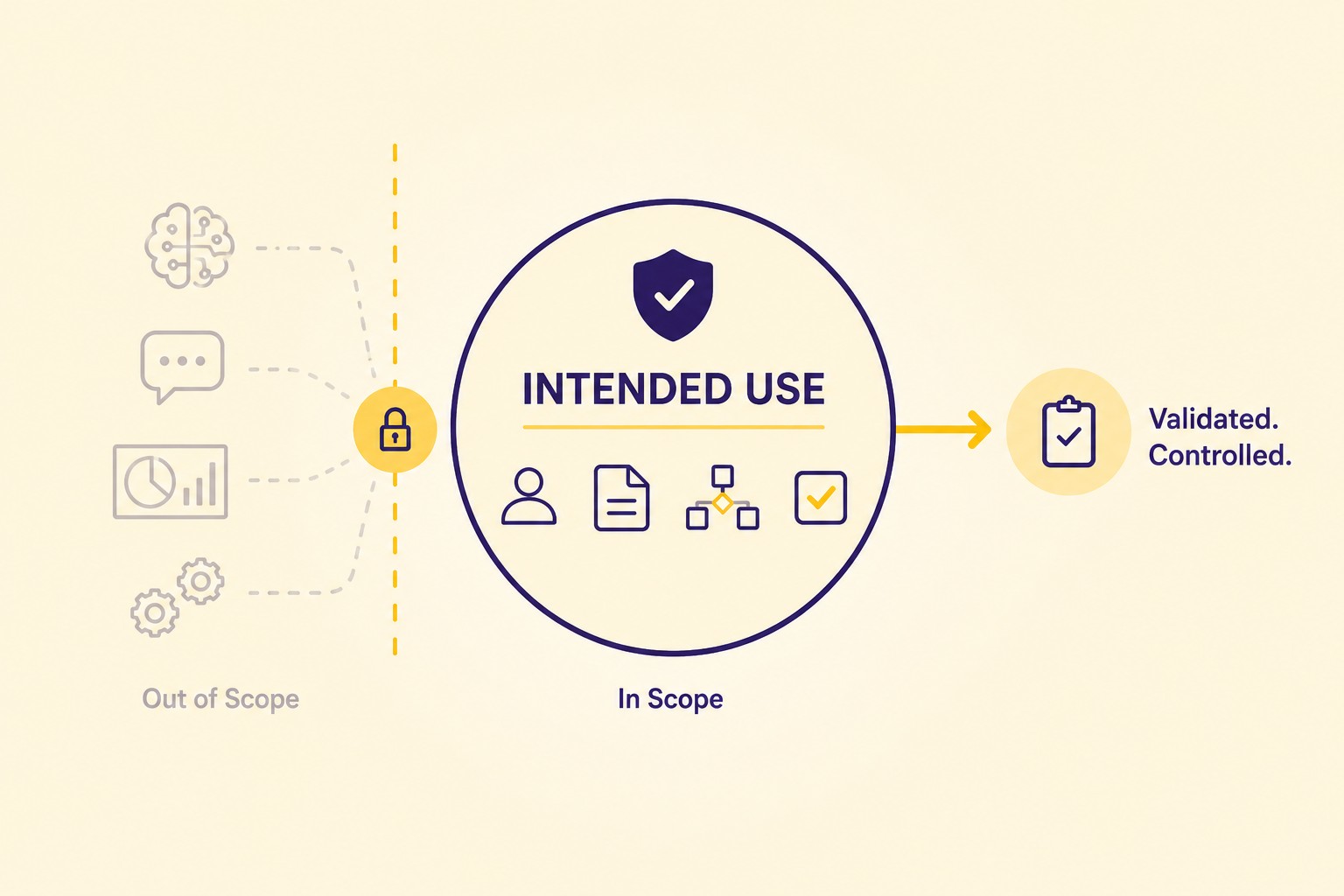
Defining intended use is one of the most important steps in validating AI and SaaS tools in regulated pharma and biotech environments. The intended use statement establishes validation scope, testing strategy, risk classification, supplier oversight expectations, and procedural controls.
For AI systems, this is often more difficult than traditional software because operational usage can evolve quickly after deployment. A tool that initially provides informational support may later influence GMP decisions, investigations, or batch review activities.
During inspections and internal audits, organizations are often asked to demonstrate that actual system usage aligns with the documented intended use, validation approach, and procedural controls.
Why Intended Use Matters in GxP Environments
In regulated environments, intended use is not simply a software description. It defines how the organization expects the system to be used within GMP workflows and regulated business processes.
That distinction matters because validation scope should align to actual regulated use — not vendor capability lists or product marketing descriptions.
For AI and SaaS platforms, intended use directly impacts:
- validation scope
- CSA strategy
- risk assessments
- testing depth
- supplier qualification
- data integrity controls
- procedural controls
- periodic review expectations
- change impact assessments
A common audit observation is that operational use gradually expands over time while validation documentation and governance controls remain unchanged.
This happens frequently with AI-enabled workflows.
Why AI Tools Are Harder to Scope Than Traditional Systems
Traditional validated systems typically perform predictable workflows such as:
- deviation management
- training management
- document control
- MES execution
- LIMS sample tracking
- audit management
AI systems are different because users may begin relying on generated outputs in ways that were not originally anticipated.
For example:
- an AI tool initially used for informational summaries may later influence investigation decisions
- AI-generated trend analysis may begin driving CAPA prioritization
- users may operationally trust AI-generated recommendations more heavily over time
The biggest risk is not necessarily that the intended use statement is incomplete on day one. The bigger risk is that operational reliance evolves while validation scope, testing rationale, and procedural controls do not evolve with it.
Organizations frequently underestimate how quickly this occurs.
A Practical Formula for Writing an Intended Use Statement
Many intended use statements fail because they are too broad or too vague.
A practical intended use statement should define:
System + user role + GxP process + data source + output usage + decision impact + review boundary
A strong intended use statement should clearly answer:
- Who uses the system?
- What regulated process does it support?
- What data does it process?
- What outputs are generated?
- Are outputs informational, decision-supporting, or automated?
- Who reviews outputs before action is taken?
- Does the system create, modify, approve, or store regulated records?
The statement should describe operational reality rather than high-level business goals.
Weak vs Strong Intended Use Statements
| Weak Intended Use | Strong Intended Use |
|---|---|
| “AI tool used to improve quality operations.” | “AI-assisted platform used by QA personnel to summarize deviation records and identify recurring event patterns for investigator review prior to final QA approval.” |
| “System supports batch record review.” | “AI-supported workflow used by manufacturing and QA personnel to identify missing entries, inconsistencies, and exception trends within electronic batch records. Final batch disposition decisions remain fully manual.” |
| “Cloud-based quality platform.” | “SaaS quality management platform used to manage deviations, CAPAs, change controls, audit workflows, and electronic approvals within the site QMS.” |
| “AI supports environmental monitoring review.” | “AI-assisted analytics platform used by microbiology personnel to identify abnormal environmental monitoring trends requiring SME assessment prior to investigation initiation.” |
Weak statements are difficult to validate because they do not establish operational boundaries.
Strong statements define:
- workflow usage
- user responsibilities
- review expectations
- regulated impact
- decision ownership
This becomes especially important during risk assessments and test strategy development.
SaaS Intended Use Requires More Than “Cloud QMS”
For SaaS platforms, intended use should define more than the software category itself.
Organizations should also define:
- enabled modules
- configured workflows
- integrations
- electronic signatures
- audit trail reliance
- report usage
- source-of-truth ownership
- user roles and permissions
- whether records are GMP records
For example, two organizations may both use the same SaaS eQMS platform, but intended use — and validation scope — may differ significantly depending on configuration, integrations, and operational reliance.
This frequently surfaces during supplier qualification activities and periodic reviews.
Informational AI vs Decision-Support AI vs Automated AI Workflows
Not all AI systems carry the same validation expectations or assurance requirements.
The level of validation effort should align with intended use, process impact, data integrity risk, and the extent to which users rely on generated outputs within regulated workflows.
Informational AI
Informational AI provides outputs for reference but does not directly support GMP decision-making.
Examples include:
- SOP summarization
- meeting note generation
- training assistance
- knowledge retrieval
- draft report generation
These systems may still require governance controls, access controls, supplier assessments, and procedural restrictions depending on deployment and usage.
However, testing expectations are generally lower when outputs are not used to support regulated decisions or regulated records.
Decision-Support AI
Decision-support AI supports regulated workflows while still requiring human review and approval prior to action.
Examples include:
- deviation categorization recommendations
- environmental monitoring trend analysis
- supplier audit finding prioritization
- MBR comparison support
- batch review assistance
This category typically requires increased validation activities because the organization must demonstrate:
- how outputs are reviewed
- how users verify recommendations
- how incorrect outputs are identified
- how procedural controls prevent inappropriate reliance on AI-generated content
This is where many organizations encounter challenges during audits and internal assessments.
Automated AI Workflows
AI-driven workflows that automatically trigger actions within GMP processes generally require substantially more extensive testing and procedural controls.
Examples may include:
- automated workflow routing
- AI-triggered notifications
- automated exception escalation
- AI-assisted release gating logic
Fully autonomous GMP decision-making remains relatively uncommon in regulated manufacturing environments. Most organizations still maintain human approval checkpoints for direct-impact quality and manufacturing activities.
Where automated AI functionality directly impacts GMP decisions, organizations should expect:
- expanded risk assessments
- additional verification activities
- increased testing depth
- stronger change management controls
- clearly defined procedural oversight
How Intended Use Impacts Validation Scope
Validation scope should align to actual regulated usage — not all possible system functionality.
For SaaS and AI platforms, organizations should define which configured workflows, modules, integrations, and outputs fall within regulated scope.
A system classified as informational may require limited functional verification focused on:
- access controls
- audit trails
- security roles
- data integrity controls
- procedural restrictions
- record retention
However, informational classification alone does not automatically reduce assurance expectations. Organizations still need to assess whether users operationally rely on generated outputs within GMP workflows.
A decision-support AI used within quality or manufacturing processes may require:
- workflow verification
- challenge testing
- known-error testing
- output verification
- procedural verification
- traceability to intended use and procedural controls
Organizations frequently struggle to justify reduced testing when AI-generated outputs influence quality decisions, manufacturing review activities, or regulated records.
Human Review Is Not Automatically a Control
Many organizations state that “human review” mitigates AI risk.
In practice, this is only effective if the review process is operationally defined and consistently executed.
If human review is the primary control, procedures should clearly define:
- who performs the review
- what the reviewer is expected to verify
- what evidence is retained
- how discrepancies are handled
- when outputs must be rejected
- escalation expectations
Otherwise, “human-in-the-loop” becomes a conceptual statement rather than an effective GMP control.
This becomes especially important when AI-generated outputs support deviation investigations, batch review activities, CAPA prioritization, or quality event assessments.
Common Mistakes Companies Make
Overly Broad Intended Use Statements
Broad intended use statements create uncontrolled validation scope.
If the intended use says the AI “supports quality operations,” auditors may reasonably ask:
- which workflows?
- which records?
- which users?
- which decisions?
- which controls?
Assuming Internal Systems Are Non-GxP
An internal system can still be GxP relevant if it influences regulated decisions or regulated records.
The deployment location does not determine validation expectations.
Operational impact does.
Allowing Operational Use to Expand Informally
A common issue is that users gradually rely on AI outputs more heavily over time without updating:
- intended use
- risk assessments
- procedures
- validation rationale
- testing strategy
- governance controls
This frequently surfaces during internal audits and periodic reviews.
Assuming Supplier Documentation Replaces Validation
Supplier testing alone is generally insufficient.
Organizations still need to demonstrate that the system is fit for their own intended regulated use, workflows, integrations, and procedures.
What Auditors and Inspectors Typically Ask
Auditors rarely begin by asking whether a company uses AI.
They typically begin by asking how the system is actually used operationally.
Common inspection questions include:
- What regulated decisions does the AI influence?
- How are outputs verified?
- Who owns final approval?
- What happens if the AI output is incorrect?
- Has actual use changed since implementation?
- How are SaaS or model updates assessed?
- Which controls prevent overreliance on AI-generated outputs?
- What evidence demonstrates reviewer verification?
One of the most common governance gaps is that operational reliance evolves faster than validation documentation.
When Validation Complexity Increases
Validation and governance complexity generally increase when:
- AI outputs influence GMP decisions
- AI-generated content enters regulated records
- workflows become increasingly automated
- models retrain dynamically
- multiple GxP systems exchange AI-generated data
- enterprise AI platforms are deployed across sites
- local workflows differ between business units
Cross-site deployments are particularly challenging because intended use, procedural controls, and operational reliance may vary between manufacturing sites even when the same platform is used.
This often results in differences in validation scope, testing approach, and procedural requirements across organizations or business units.
Final Perspective
For AI and SaaS tools in pharma, intended use is not simply a documentation exercise. It defines validation boundaries, governance expectations, testing rationale, operational accountability, and inspection defensibility.
The strongest intended use statements are operationally specific, aligned to real workflows, and continuously reassessed as system usage evolves.
To learn more, reach out to Assurea.