

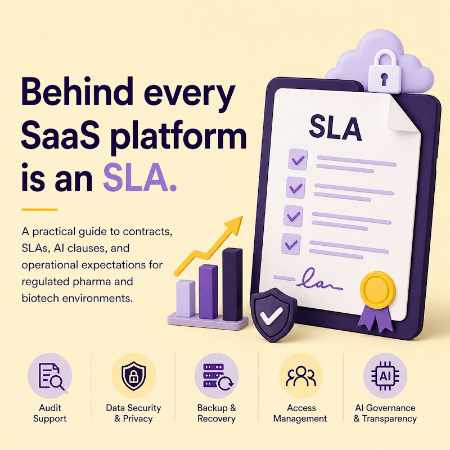
Pharma companies cannot rely on standard commercial SaaS contracts alone when regulated systems, GxP data, or AI-enabled workflows are involved. In regulated environments, contracts and SLAs help define operational oversight expectations that support validation, data integrity, cybersecurity, supplier governance, and inspection readiness.
Most commercial agreements are designed around uptime and commercial liability. Pharma and biotech teams typically need additional clarity around audit support, change notifications, backup and recovery expectations, AI model governance, subcontractor transparency, and data ownership responsibilities.
During inspections, auditors commonly ask organizations to demonstrate how vendor oversight responsibilities were defined, maintained, and reviewed throughout the system lifecycle.
Why Standard SaaS Contracts Need GxP-Specific Additions
Most SaaS agreements are written for general enterprise software use. They usually cover commercial terms, pricing, uptime, and support expectations.
In GxP environments, organizations also need the agreement structure to support:
- validation activities
- electronic records controls
- supplier oversight
- business continuity expectations
- data integrity controls
- audit readiness
- cybersecurity governance
- AI oversight expectations
A standard SaaS contract may already contain useful operational language, but regulated environments often require additional detail to clearly define responsibilities between the vendor and the regulated company.
The objective is not to create unnecessary complexity. The objective is to ensure operational expectations are aligned before the system becomes part of regulated workflows.
What Different Vendor Agreements Actually Cover
Master Service Agreement (MSA)
The MSA defines the broader legal and commercial relationship between the vendor and customer.
Typical areas include:
- commercial terms
- payment structure
- intellectual property
- liability
- termination rights
- confidentiality
- high-level responsibilities
The MSA usually establishes the relationship framework but does not fully define GxP operational oversight expectations.
Service Level Agreement (SLA)
The SLA defines measurable operational service expectations.
This commonly includes:
- uptime commitments
- support response timelines
- maintenance windows
- disaster recovery expectations
- escalation timelines
- system availability targets
In regulated environments, SLA expectations often need to align with operational impact. For example, recovery expectations for a manufacturing or laboratory platform may require more detail than a standard enterprise IT application.
Quality Agreement
The Quality Agreement defines GxP-related operational responsibilities between the regulated company and the vendor.
This may include:
- change notification expectations
- audit participation
- validation support
- deviation handling
- CAPA support
- documentation retention
- data integrity responsibilities
- electronic records expectations
Auditors frequently ask how supplier quality responsibilities were formally established and maintained.
Security or Data Protection Agreement
This agreement focuses on cybersecurity and data governance expectations.
Common areas include:
- encryption
- access management
- privileged account oversight
- security monitoring
- breach notification timelines
- backup and recovery controls
- subcontractor governance
- infrastructure hosting expectations
AI-enabled platforms increasingly require additional governance language related to model usage and customer data handling.
Contract Clauses Pharma Teams Commonly Add for SaaS and AI Platforms
Audit Support Expectations
The agreement should define whether the vendor:
- supports customer audits
- provides quality and security documentation
- participates in supplier assessments
- supports regulatory inspection requests when applicable
Organizations often benefit from defining expected response timelines for audit documentation requests.
Change Notification Requirements
Pharma companies commonly require notification thresholds for:
- major releases
- infrastructure changes
- security-impacting changes
- AI model updates
- changes affecting validated functionality
Auditors typically ask how vendor-driven SaaS updates are assessed within the company’s change management process.
Backup and Recovery Responsibilities
The agreement should clearly define:
- backup frequency
- retention expectations
- recovery timelines
- restore testing expectations
- archive accessibility
- responsibilities during recovery events
Cloud hosting alone does not automatically define recovery governance expectations.
Data Ownership and Export Rights
Contracts should clearly define:
- customer ownership of regulated data
- export rights during termination
- archive retrieval expectations
- deletion timelines
- structured export formats where applicable
This becomes particularly important during migrations or vendor transitions.
AI Model Usage and Training Clauses
AI-enabled platforms increasingly require additional governance language.
Organizations commonly define:
- whether customer data is used for model training
- whether prompts are retained
- tenant segregation expectations
- AI feature notification expectations
- model update communication processes
- human review expectations for AI-supported workflows
This area is receiving increased internal governance attention across pharma and biotech organizations.
Subcontractor Transparency
Many SaaS vendors rely on cloud providers, infrastructure partners, support organizations, or AI service providers.
Pharma organizations commonly request visibility into:
- critical subcontractors
- hosting regions
- support models
- infrastructure ownership
- third-party access expectations
Access Control Responsibilities
The agreement should define who is responsible for:
- user provisioning
- privileged access management
- periodic access reviews
- authentication controls
- logging expectations
- account deactivation timelines
This often surfaces during data integrity and cybersecurity reviews.
Incident Response Timelines
Security and operational incident handling expectations should be clearly defined.
This commonly includes:
- notification timelines
- escalation expectations
- communication responsibilities
- investigation support
- root cause documentation expectations
- resolution tracking
Retention and Archive Expectations
Regulated organizations often require clarity around:
- archive duration
- retrieval timelines
- retention configuration ownership
- audit trail retention
- accessibility of historical records
This becomes increasingly important for long-term regulated record retention requirements.
What Auditors and Inspectors Typically Ask
Inspectors usually focus less on the existence of the contract itself and more on how oversight responsibilities were operationally managed.
Common questions include:
- How are vendor changes assessed?
- How are SaaS releases reviewed?
- How are backup and recovery capabilities verified?
- How are AI-enabled features governed?
- How does the organization oversee subcontractors?
- How are incidents escalated and documented?
- How are electronic records retained and retrieved?
Organizations often benefit from having responsibilities clearly defined across QA, IT, cybersecurity, procurement, system owners, and vendors.
Real Operational Gaps Commonly Seen During Implementations
One common situation is that procurement and business teams finalize agreements before QA, IT, CSV, or cybersecurity teams review operational clauses. Later during implementation, teams realize additional governance expectations need to be documented.
Another common scenario involves AI-enabled functionality being introduced into existing platforms over time. The original vendor agreement may predate AI features entirely, creating a need for updated governance expectations around model usage, prompts, retention, and oversight.
Teams also frequently discover that standard SLAs define uptime expectations but do not fully define regulated recovery expectations tied to manufacturing, laboratory, or quality operations.
When Vendor Oversight Complexity Increases
Vendor oversight expectations generally increase when:
- AI functionality is introduced
- regulated records are externally hosted
- systems support manufacturing operations
- multiple GxP systems are integrated
- continuous deployment models are used
- vendors maintain privileged administrative access
- global infrastructure hosting is involved
- subcontractors support critical operations
The governance approach for a standalone business SaaS tool is very different from the oversight model required for a regulated AI-enabled operational platform.
Practical Perspective for Pharma Digital Teams
Well-structured vendor agreements help create clearer operational alignment between the software provider and the regulated company. They also help support validation activities, supplier oversight, inspection readiness, and long-term operational governance.
As SaaS and AI platforms continue expanding across regulated environments, organizations are increasingly treating contract structure, SLA expectations, cybersecurity governance, and quality oversight as part of the broader digital compliance lifecycle rather than separate procurement activities.