
An AI governance framework for pharma works only when it goes beyond policy. It needs to connect each AI use case to a clear intended use, a defined risk tier, required controls, and ongoing monitoring. That is what makes the framework usable in practice and defensible in audit. If those links are missing, the framework may look complete on paper but still fail under real review.
In pharma, the real question is not whether AI is allowed. The real question is whether each use case can be justified, controlled, and reviewed over time.
What a practical AI governance framework for pharma must include
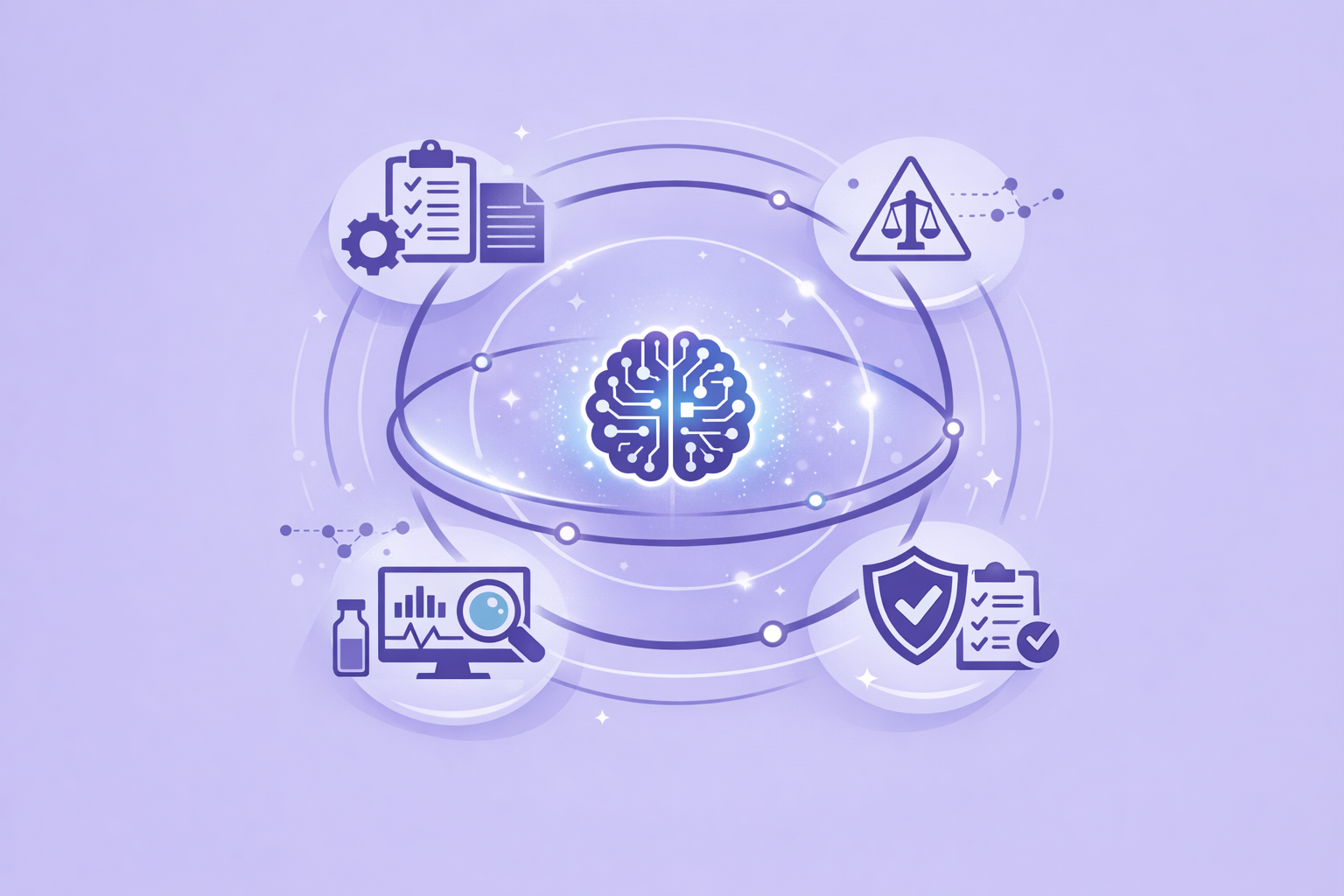
A practical AI governance framework for pharma should include five working parts: policy, use case intake, risk classification, required controls, and monitoring. These parts need to work together. If they sit in separate documents without a clear process behind them, governance usually becomes inconsistent across teams.
The policy sets the boundaries. It should define what AI use is allowed, restricted, or prohibited. It should also define baseline rules for data entry, human review, escalation, and change assessment. But policy alone is not the framework.
The intake process is where governance becomes real. Every proposed AI use case should be reviewed against intended use, input data, output type, user role, system touchpoints, and decision impact. This is where the organization decides whether the use case is low risk, GxP-adjacent, or capable of influencing regulated work.
The risk model should classify the use case, not just the tool. That distinction matters. The same model can carry very different risk depending on how it is being used. Drafting a meeting summary is not the same as supporting deviation review or batch assessment. AI risk in pharma is driven by context of use, decision impact, and consequence of error, not by the model name alone.
The framework should then assign required controls by risk tier. This is where many programs become too vague. If controls are not tied to risk, different teams will apply different standards to similar use cases.
Monitoring is what closes the loop. A practical framework should define what is monitored, who reviews it, how often it is reviewed, and what triggers escalation or reassessment. AI governance becomes weak when approval is documented once, but ongoing performance, workflow drift, and model change are not reviewed afterward.
The minimum components
At minimum, a usable framework should answer these questions:
- What is the intended use of the AI workflow?
- What data is allowed or prohibited?
- What risk tier applies?
- What controls are mandatory for that tier?
- What human review is required?
- What changes trigger reassessment?
- What performance indicators must be monitored?
- What evidence is retained?
Why policy alone is not enough
A common weakness is relying on a high-level AI policy as if it were the full control model. That rarely holds up in practice. Auditors do not usually stop at the policy. They ask how a specific use case was approved, what controls were required, and how the organization knows the tool is still being used appropriately.
A governance framework works when it answers those operational questions consistently.
A simple control model by AI use case risk
A strong AI governance framework for pharma does not treat all AI use cases the same. It applies different controls based on how the AI is used and what decisions it can influence.
| Risk tier | Typical use case | Minimum governance expectation |
| Low | Internal drafting, note summarization, non-GxP productivity support | Approved use policy, defined data restrictions, approved tool list, basic user guidance |
| Moderate | SOP comparison, technical writing support, trend summaries, GxP-adjacent review support | Intended use record, documented risk assessment, defined human verification, change review, monitoring plan |
| High | AI influencing deviation review, complaint escalation, batch assessment, or other regulated decisions | Formal governance review, strict intended use, role-based access, documented verification steps, evidence retention, change control, monitoring thresholds, escalation path, periodic review |
This type of table makes the framework usable. It shows that controls should increase with decision impact and compliance consequence.
Low-risk use cases
Low-risk use cases are usually assistive and non-GxP. They still need boundaries, especially around confidential data and acceptable use, but they do not usually need a heavy governance path.
Moderate-risk use cases
Moderate-risk use cases are often where teams get inconsistent. These workflows may not make the final decision, but they can still shape how work is reviewed, summarized, or prioritized. That is where governance needs clearer intended use, clearer reviewer responsibility, and clearer limits on reliance.
High-risk use cases
High-risk use cases need the strongest discipline. If the output can influence quality decisions, manufacturing review, release support, investigations, complaint handling, or other regulated processes, the framework should require stronger verification, stronger evidence, tighter change review, and clear escalation rules.
What inspectors and auditors actually ask about AI governance
This is where many frameworks are tested. During inspection, the discussion usually moves quickly away from broad policy language and toward control, traceability, and evidence.
Approval and intended use
How did you decide this AI use case was acceptable?
The organization should be able to show documented intended use, risk classification, required controls, and approval before deployment. If that chain is missing, governance is weak even if an AI policy exists.
What is the AI actually allowed to do?
Inspectors often want to see boundaries, not just principles. That includes approved use cases, restricted use cases, prohibited data types, user limitations, and rules for when output cannot be relied upon.
How do you distinguish general productivity use from regulated use?
A practical framework should show how the company separates low-risk administrative use from workflows that influence GxP records, reviews, or decisions. This often surfaces in audits when teams describe a use case as assistive, but users rely on it to shape regulated actions.
Human review and decision accountability
What makes human oversight meaningful?
Saying that a human reviews the output is not enough. Auditors typically ask what the reviewer is expected to verify, whether they can detect an error, and whether the review is documented where required. Human review is only a real control when the reviewer has a defined verification task and enough context to challenge the output.
Who is accountable for the final decision?
The framework should make clear that AI output does not remove accountability from process owners, reviewers, or approvers. Organizations struggle to justify governance when the AI is described as assistive, but users cannot explain how they independently confirm the result.
Change control and monitoring
How do you handle model, prompt, or workflow changes?
The framework should define what kinds of changes trigger reassessment. That may include vendor model updates, prompt changes, retrieval logic changes, new input data, or expanded workflow use. This often surfaces in audits when a tool changed materially after approval, but governance records were not updated.
How do you know the system is still performing acceptably?
The answer should include monitoring metrics, review frequency, exception handling, and thresholds for restriction or reapproval. Monitoring may include override rate, error patterns, escalation frequency, output inconsistency, or critical exceptions.
What evidence do you retain?
Inspectors typically expect more than policy statements. They want to see approval records, risk assessments, control expectations, change review records, and evidence that ongoing monitoring is happening. In pharma, AI governance often fails at the point where policy exists but use case evidence does not.
Practical perspective
The AI governance frameworks that work in pharma are the ones that turn policy into repeatable control. They define intended use, classify risk, assign mandatory controls, require meaningful review, and monitor performance after release. That is what makes the framework usable internally and defensible in inspection.
FAQ
What should an AI governance framework include in pharma?
It should include an AI policy, use case intake, risk classification, control requirements by risk tier, monitoring expectations, change review criteria, and retained evidence. These elements need to function as one operating model rather than separate documents.
How do pharmaceutical companies classify AI use case risk?
They usually classify risk based on intended use, impact on decisions, GxP relevance, degree of automation, data sensitivity, and consequence of error. A stronger framework classifies the use case, not just the underlying model.
What do inspectors ask about AI governance in regulated environments?
They usually ask how the use case was approved, what boundaries apply, how human review works, how changes are assessed, what is monitored over time, and what evidence supports the controlled state of the workflow.