

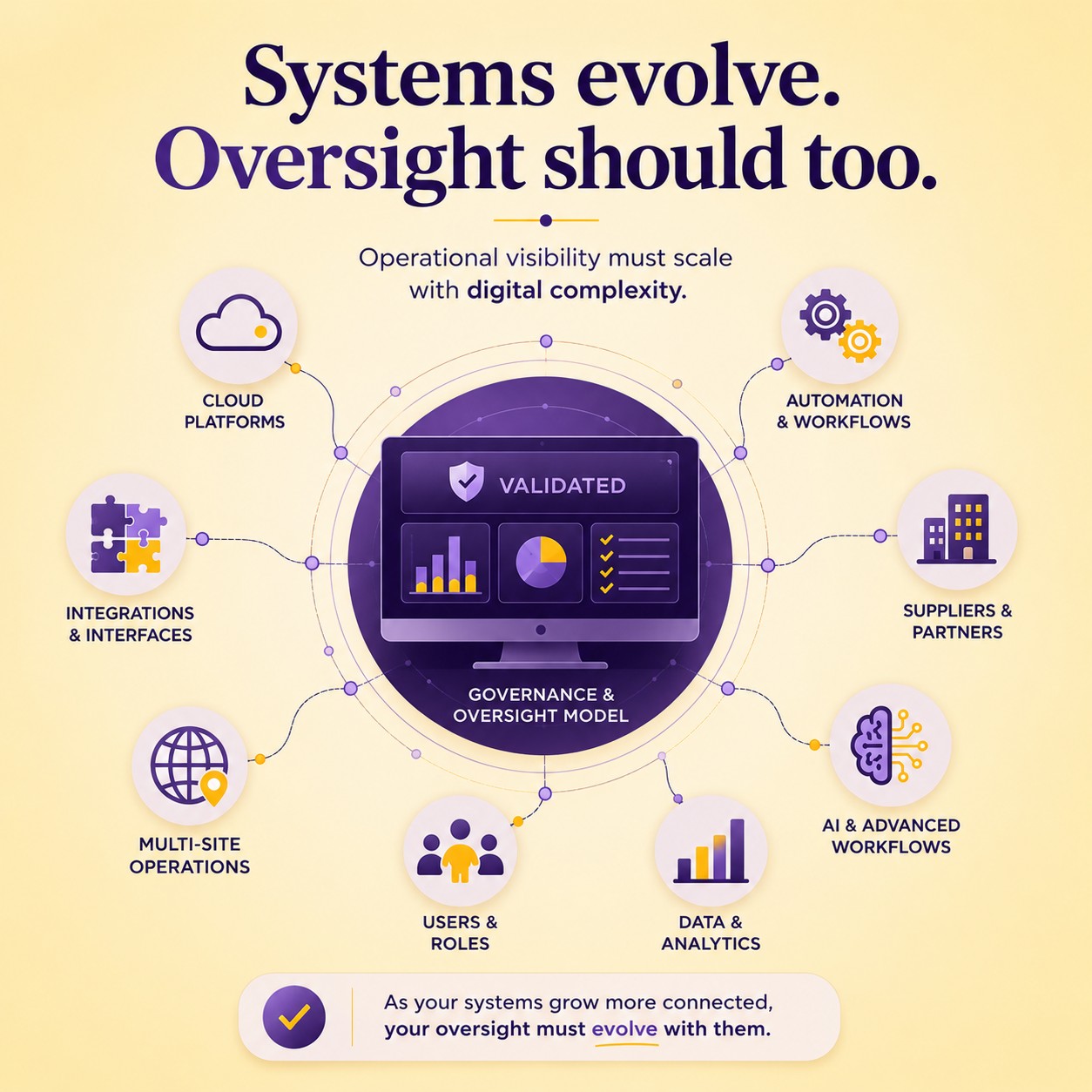
In pharma and biotech, digital systems rarely stay the same after they go live. Workflows change, users increase, integrations are added, suppliers release updates, and the system becomes part of a larger operational environment.
The real challenge is that oversight does not always evolve at the same pace.
A system may still be validated, documented, and functioning as expected, while the way it is being used has changed significantly. This gap between the documented control model and the current operating reality is what many teams experience as oversight drift in regulated digital systems.
Oversight drift is becoming more common as regulated organizations adopt cloud platforms, multi-site systems, AI-enabled workflows, and highly connected digital ecosystems.
What Oversight Drift Actually Looks Like in Practice
Oversight drift rarely appears as one major breakdown. More often, it develops slowly through operational growth.
Processes continue.
Reviews continue.
Systems remain active.
Documentation still exists.
But over time, organizations begin realizing that the visibility they once had into the environment is no longer as strong or as centralized as it used to be.
A common example is a system that originally supported:
- one site,
- a smaller user base,
- limited integrations,
- and slower operational change cycles.
Several years later, that same environment may include:
- multiple global sites,
- external vendors,
- automated interfaces,
- analytics platforms,
- cloud integrations,
- AI-supported workflows,
- and significantly higher system activity.
The oversight model may not have evolved at the same pace.
That gap is where oversight drift often begins.
The System May Still Be Validated, but the Environment Has Changed
One of the more common operational realities in biotech is that systems continue evolving long after implementation is complete.
Over time:
- workflows change,
- user groups expand,
- integrations increase,
- ownership structures shift,
- suppliers change,
- and operational dependencies grow.
The original validation may still be appropriate for the intended use at the time it was executed. However, organizations often discover that the surrounding governance model no longer reflects how the system actually operates today.
This is why many digital oversight discussions are shifting away from static validation thinking and toward lifecycle visibility.
During inspection, regulators commonly focus on how organizations maintained operational awareness as the environment evolved over time.
Reviews Continue Happening, but Operational Visibility Changes
One of the clearest examples of oversight drift is when oversight activities continue operationally, but their effectiveness becomes harder to maintain as complexity increases.
Audit trail reviews become volume-driven
A review process that worked well for a smaller environment may become increasingly difficult once:
- system activity increases,
- integrations expand,
- and event volumes multiply.
Organizations often begin reassessing:
- which events are truly critical,
- what requires escalation,
- and how reviewers can maintain meaningful visibility into operational risk.
This is why many mature organizations move toward more risk-based review approaches rather than attempting to assess every event with equal depth.
During inspection, auditors commonly ask:
- How are critical events defined?
- What triggers deeper review?
- How does the organization identify anomalous activity?
These questions are often intended to understand whether the oversight process still reflects the current operational environment.
Periodic reviews become harder to operationalize
Periodic reviews often begin as highly effective lifecycle oversight activities.
Over time, however, organizations sometimes realize that:
- the environment changed significantly,
- integrations expanded,
- workflows evolved,
- and operational dependencies increased,
while the review structure itself remained relatively unchanged.
This does not mean the process failed. In many cases, it reflects that the business matured faster than the review model originally anticipated.
Organizations increasingly evolve periodic reviews into broader operational assessments that include:
- trend analysis,
- recurring deviations,
- access patterns,
- integration visibility,
- and cumulative system changes over time.
Ownership Structures Become More Distributed
As digital ecosystems mature, oversight responsibilities naturally become more cross-functional.
For example:
- QA may oversee procedural governance,
- IT may manage infrastructure,
- business teams may manage workflows,
- suppliers may manage releases,
- and external partners may support integrations or analytics.
This is common in modern regulated environments.
However, as responsibilities become more distributed, organizations often reassess whether:
- ownership remains sufficiently clear,
- escalation pathways remain visible,
- and operational decisions are still connected across functions.
Oversight drift often develops when visibility becomes fragmented rather than intentionally coordinated.
SaaS and AI Environments Accelerate Oversight Drift
Modern cloud environments evolve continuously.
Unlike traditional systems with slower upgrade cycles, SaaS platforms may introduce:
- frequent releases,
- configuration changes,
- evolving integrations,
- and new functionality throughout the operational lifecycle.
AI-enabled workflows introduce additional layers involving:
- data lineage,
- prompt governance,
- model monitoring,
- output verification,
- and evolving risk profiles.
Many governance programs were originally designed for more static environments. As organizations adopt faster and more dynamic technologies, oversight models often need to mature accordingly.
This is one reason lifecycle oversight is becoming a larger discussion across regulated digital operations.
Common Questions Organizations Begin Asking
As environments become more interconnected, organizations often begin reassessing whether their oversight models still align with operational reality.
Common questions include:
Are we reviewing the right things or simply reviewing more things?
As event volume grows, organizations often shift toward risk-based prioritization rather than expanding review activity indefinitely.
Does our governance structure still reflect how the system operates today?
This question becomes increasingly relevant after:
- cloud migrations,
- acquisitions,
- AI implementation,
- major integrations,
- or global expansion.
Are responsibilities still operationally connected?
Cross-functional environments work best when:
- ownership remains visible,
- escalation pathways remain clear,
- and operational decisions remain connected across teams.
Are our oversight activities still giving us meaningful operational visibility?
Many organizations evolve beyond completion-focused oversight toward approaches that provide broader visibility into:
- trends,
- recurring events,
- operational dependencies,
- and lifecycle system health.
Oversight Drift Is Often a Sign of Organizational Growth
One of the most important realities about oversight drift is that it often appears in organizations that are actively evolving and expanding.
In many cases, the underlying issue is not lack of effort or lack of compliance focus.
The challenge is that:
- digital environments matured,
- operational complexity increased,
- and governance structures needed to evolve alongside them.
This is why many organizations now treat digital oversight as a continuously evolving operational capability rather than a static compliance framework established only during implementation.
Building Oversight Models That Scale with the Environment
Organizations that manage digital growth effectively often revisit oversight structures periodically as part of operational maturity.
In practice, scalable oversight programs commonly include:
- risk-based review strategies,
- lifecycle reassessment,
- operational trend analysis,
- clear ownership visibility,
- supplier monitoring beyond onboarding,
- and governance models that evolve alongside the environment itself.
As regulated digital ecosystems continue becoming more integrated, cloud-connected, and operationally dynamic, oversight maturity increasingly depends on how well organizations maintain visibility into how systems are actually functioning in practice — not only how they were originally designed.