

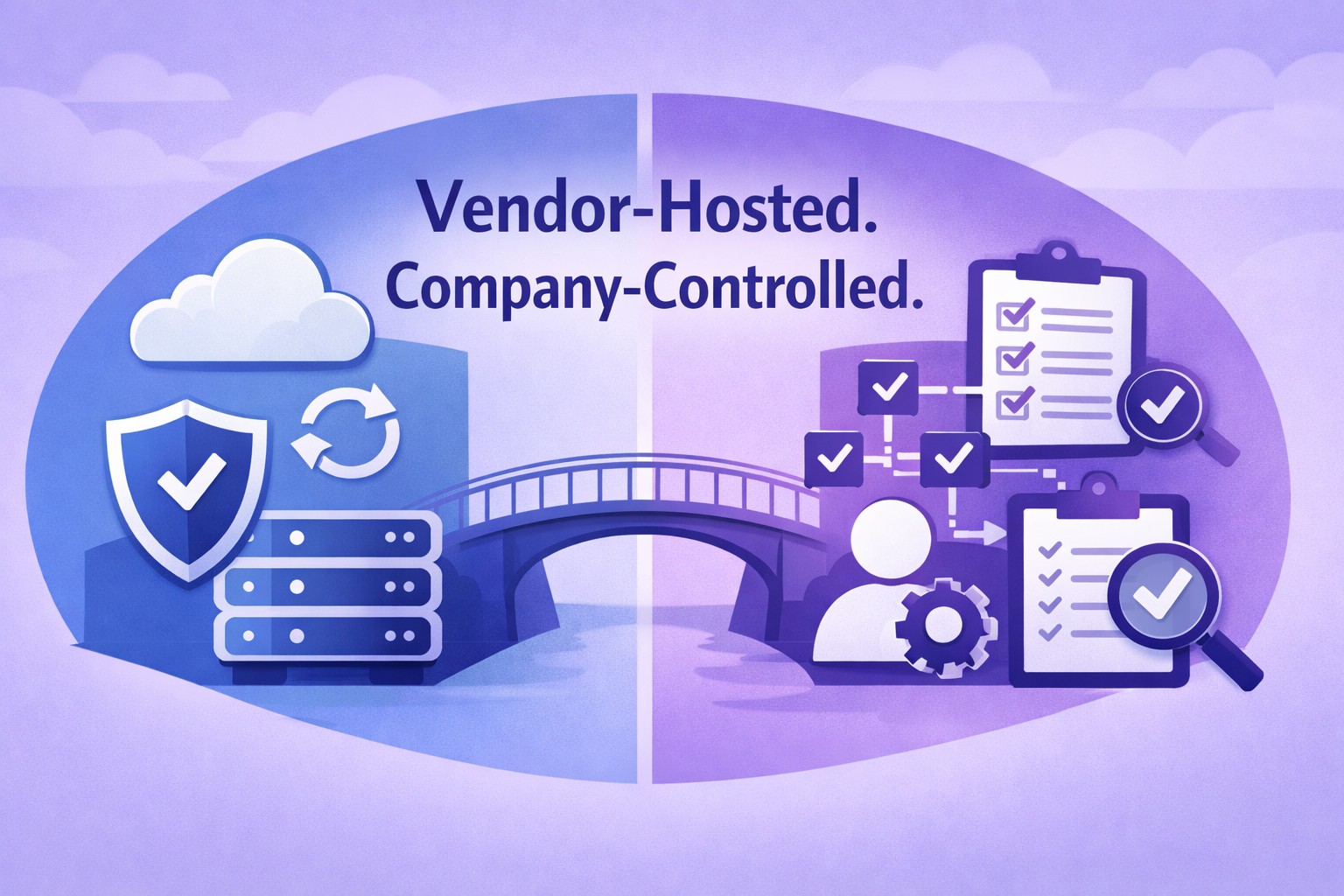
SaaS and cloud validation is different because the regulated company no longer controls the full technical stack, but it still owns intended use, oversight, data integrity, access, and compliance.
When a system is vendor-hosted, the validation work does not go away. It shifts. Instead of focusing mainly on internally managed infrastructure, the company has to focus on supplier oversight, configured workflows, risk assessment, access control, data governance, and ongoing review of changes.
In other words: cloud delivery changes the operating model, not the compliance expectation.
Why SaaS and cloud validation is different
In a traditional on-premise environment, the company usually has direct control over servers, infrastructure, deployment timing, and local system administration.
In a SaaS or cloud model, that control is shared.
The vendor may manage hosting, platform maintenance, upgrades, backups, or parts of the security architecture. The regulated company still has to show that the system, as configured and used, is fit for its intended purpose.
That means validation in SaaS and cloud environments often depends on five things more than teams initially expect.
1. Shared responsibility
The vendor may own the platform, but the regulated company still owns the process being supported.
That includes:
- how the system is used
- which workflows are GxP-relevant
- who has access
- how roles are assigned
- how the system fits into quality and operational procedures
A vendor can support compliance, but it cannot own the regulated company’s responsibility.
2. Continuous change
SaaS systems change more often than many traditional systems.
New releases, patches, feature updates, and configuration changes can affect validated workflows over time. A validated state is not something a company achieves once and assumes forever. It has to be maintained through a controlled process for reviewing changes and determining impact.
3. Less technical visibility
In many cloud models, the customer does not have direct access to the full backend infrastructure.
That is not automatically a problem, but it does mean the company must rely more intentionally on vendor documentation, supplier qualification, service agreements, and internal procedures to justify control.
4. Configuration matters more
With many SaaS platforms, the biggest compliance risk is not the base software itself.
It is the way the company configures the system:
- roles and permissions
- workflow routing
- approval logic
- notifications
- audit trail settings
- reports
- interfaces
- retention rules
The platform may be standard. The risk often sits in the customer-specific setup.
5. Ongoing oversight is essential
Cloud validation is not just about implementation.
It is also about what happens after go-live:
- how updates are reviewed
- how incidents are tracked
- how access is reviewed
- how periodic evaluation is performed
- how the company confirms the system remains in a controlled state
A simple way to think about it
SaaS and cloud validation is not lighter because the system is hosted elsewhere. It is different because the evidence comes from more than one place:
- the vendor
- the regulated company
- the configuration itself
- the operating procedures around the system
That combination is what has to stand up during inspection.
What inspectors really ask
When inspectors review SaaS or cloud systems, they are usually not focused on whether the platform is trendy, modern, or externally hosted. They want to understand whether the company can clearly explain how control is maintained.
Below are the types of questions that matter most.
Who owns which controls?
This is often the first weakness that shows up. If the company says the vendor handles security, backups, disaster recovery, or system maintenance, it should still be able to explain:
- what exactly the vendor owns
- what the company owns
- how those responsibilities are documented
- how the company knows those controls are adequate
If that boundary is unclear, the overall control model is usually unclear too.
How was the vendor qualified?
A company does not need to recreate the vendor’s entire software development lifecycle. But it does need to show that the supplier was assessed appropriately for the intended use of the system. That usually means looking at the vendor’s quality practices, documentation, support model, release process, security posture, and service commitments.
The question is not whether the vendor is well known. The question is whether the company performed a defensible assessment for the actual risk involved.
What is the intended use of the system?
This sounds basic, but it is often where problems begin.
A company should be able to clearly state:
- what the system does
- what process it supports
- what records it creates or manages
- what decisions rely on it
- where failure could affect product quality, patient safety, or data integrity
Without that clarity, validation often becomes generic instead of risk-based.
Which functions are GxP-critical?
Not every feature carries the same level of risk. Inspectors often want to know whether the company identified which workflows, data elements, approvals, integrations, or user actions actually matter from a GxP perspective.
A system may have many available features, but validation should focus on the functions that matter most.
How are updates assessed?
This is one of the biggest cloud-specific questions.
If the vendor releases changes regularly, the company should be able to explain how release notes are reviewed, how impact is assessed, and how decisions are made about testing, training, or procedural updates.
If the answer is “the vendor validated it,” that is usually not enough.
How are access and permissions controlled?
Inspectors will often look closely at:
- who can create, edit, approve, or delete records
- how access is granted
- how changes to access are documented
- whether role design matches actual responsibilities
- whether access is reviewed periodically
This matters because even a well-built platform can create compliance risk if permissions are too broad or poorly maintained.
Are audit trails and data changes understood?
For systems that manage GxP-relevant data, a company should understand:
- what is captured in the audit trail
- which changes are tracked
- whether audit trail review is needed
- how data changes are identified and investigated
- whether records remain attributable and complete
This is often an area where teams assume the platform is compliant by default instead of showing how it is actually used.
How is the validated state maintained after go-live?
Inspection readiness is rarely about just the implementation package.
It is also about the lifecycle after implementation:
- change control
- incident handling
- periodic review
- access review
- training updates
- system retirement or migration planning
A system can look validated at go-live and still drift into a weak state over time if none of those activities are managed consistently.
What a defensible approach usually includes
A good SaaS or cloud validation approach is not about creating the most documentation. It is about creating the right documentation and linking it to real control.
A defensible package usually includes:
- a clear intended use statement
- a documented risk assessment
- supplier qualification
- a responsibility matrix showing vendor versus customer responsibilities
- identification of GxP-relevant functions and configurations
- focused testing for critical workflows
- review of roles, permissions, and data controls
- a defined process for release and update impact assessment
- periodic review after go-live
The key is that the package should reflect how the system is actually used, not just what the vendor says the platform can do.
What companies often get wrong
A few mistakes show up again and again.
Assuming vendor documentation is enough
Vendor materials can be valuable, but they do not replace the customer’s responsibility to assess intended use, configuration, risk, and internal controls.
Treating SaaS exactly like on-premise validation
This often creates unnecessary documentation in the wrong areas while leaving true boundary risks unaddressed.
Ignoring configuration risk
Many compliance gaps come from the way the company set up the system, not from the platform itself.
Weak release management
Cloud systems evolve. If release review is inconsistent, the validated state can erode quietly.
Forgetting periodic evaluation
Validation is not only an implementation exercise. It is also a lifecycle discipline.
A practical example
A biotech company implements a cloud-based QMS for deviations, CAPAs, change control, and training.
The vendor provides standard documentation showing that the platform is developed and maintained in a controlled way. That helps, but it is only part of the picture.
The biotech company still has to validate how it is actually using the system. That includes defining its intended use, setting up the right roles and permissions, making sure approval workflows match its real quality process, and deciding how vendor updates will be reviewed and tested.
In this example, the main gap is not that the vendor documentation is missing. The main gap is that the company has not adequately controlled its own configuration and ongoing use of the system.
That is a common SaaS validation issue. The platform itself may be strong, but the compliance risk often sits in how the customer sets it up, manages changes, and maintains control after go-live.
What good looks like
A strong SaaS or cloud validation approach is usually clear, practical, and risk-based.
It shows that the company understands:
- what the system is used for
- where the GxP risk sits
- which controls belong to the vendor
- which controls belong to the company
- how changes are evaluated
- how the system remains in a valid state over time
That is what makes the difference during inspection.
Cloud delivery changes where the evidence comes from and how responsibilities are shared, but it does not remove the expectation that the regulated company understands its system, controls its process, and can explain that control clearly. To learn more, reach out to Assurea.